First Blast at Mesabi: TMCR's Minnesota Iron Ore Royalty Just Became a Production Story
The Metals Royalty Company (TMCR) just watched its Mesabi Metallics royalty asset fire its first production blast — 211,000 tons of iron ore fractured in Minnesota's first new mine in 50 years. The royalty model means TMCR shareholders get production upside without operating risk.
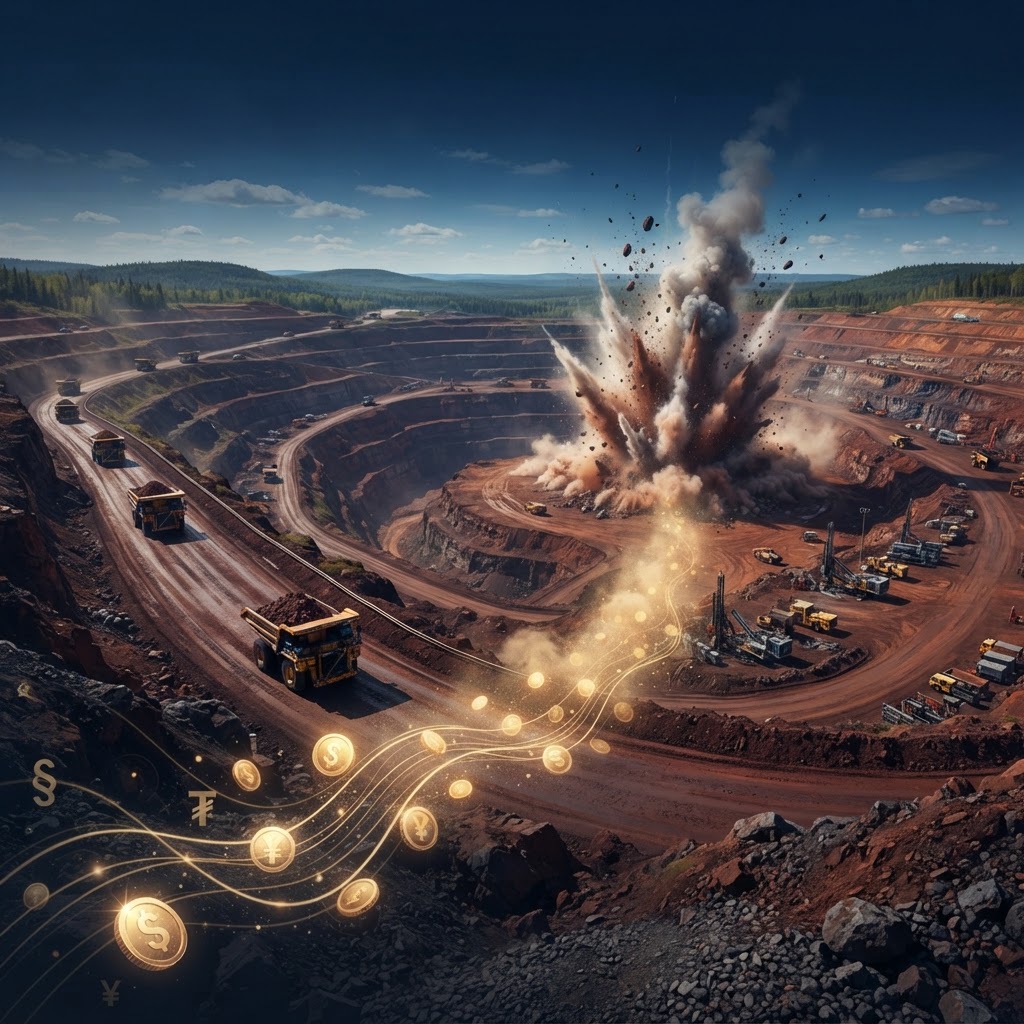
On July 10, 2026, a 66-hole blast pattern fractured approximately 211,000 tons of iron ore at the Mesabi Metallics project in Nashwauk, Minnesota. It was the first production blast at what will become the first new iron ore mine and pellet plant built in the state in half a century.
For most investors, that is an interesting construction milestone. For shareholders of The Metals Royalty Company (NASDAQ: TMCR), it is something more: the moment a royalty asset transitioned from a development story to a production story.
What TMCR Actually Owns
TMCR does not operate the Mesabi mine. Mesabi Metallics Company LLC, an Essar Group company with approximately $2.5 billion in total investment, does. What TMCR holds is a 1.0% Index-Priced Gross Overriding Production Royalty with a Revenue Floor on the project.
That structure matters. TMCR shareholders are not exposed to cost overruns, labor disputes, equipment failures, or commodity price hedging decisions at the operator level. They participate in revenue — gross revenue, not net — when pellets ship. The royalty model strips out the operational risk that crushes junior mining equity holders while preserving exposure to production volume and iron ore pricing.
The Numbers Behind the Royalty
At the planned production rate of 7.28 million tonnes per annum (Mtpa) over a 23-year mine life, TMCR's royalty is projected to generate approximately $11 million per year in royalty cash flow. There is a near-term pathway to 8.5 Mtpa, which would push annual royalty revenue to approximately $13 million.
Against TMCR's current market capitalization of roughly $379 million, that is a story about when — not whether — cash flow begins, and how it scales.
Why DR-Grade Pellets Matter
Mesabi is not producing standard iron ore fines. It is producing DR-grade pellets — direct-reduction-grade iron ore pellets that feed electric arc furnaces and direct reduced iron facilities. These are the inputs for modern, lower-carbon steelmaking.
Upon commissioning, targeted for H2 2026, Mesabi will be one of the only significant domestic producers of merchant DR-grade iron ore pellets in North America. That positioning matters in a market where U.S. steelmakers are under pressure to decarbonize and domestic supply chains are a national security priority.
The Critical Minerals Angle
TMCR describes itself as "purpose-built financing platform dedicated to advancing U.S. critical mineral security and re-industrialization." The Mesabi royalty is the flagship asset, but the company's mandate extends across metals and minerals that support defense, AI infrastructure, energy systems, and industrial capacity.
The macro tailwind is real. Federal policy — from the Defense Production Act to IRA-era incentives — is channeling capital toward domestic mineral production. A royalty company that can acquire and manage interests across that value chain is positioned to compound without the capital intensity that buries operators.
What the Blast Changes
Brian Paes-Braga, TMCR's Executive Co-Chairman and CEO, framed it plainly: "The first production blast marks the transition of our Mesabi investment from a construction story to a production story."
That is the key shift. A construction story carries execution risk — permits, financing, weather, labor. A production story carries operational risk, but for a royalty holder, that risk sits with the operator, not TMCR. The blast opened the first ramp into the bottom of the pit. 400-ton haul trucks can now commence production. Weekly blasting is expected to continue as the mine advances toward full-scale output.
Ore mined at Mesabi will be processed into DR-grade pellets subject to TMCR's royalty. First royalty revenue is anticipated as production commences and ramps.
The Risk Side
This is not a risk-free profile. TMCR has a limited operating history. The royalty cash flow projections are based on management's internal models and information provided by Mesabi Metallics — TMCR has not independently verified the operational data. Commissioning timing could slip. Iron ore prices fluctuate. And at a ~$379 million market cap against ~$11 million in projected annual royalty revenue, the stock prices in significant future growth and additional royalty acquisitions.
But the structure is sound, the asset is real, the operator is funded, and the first blast has fired on schedule. For a micro-cap royalty company, that is a compelling set of milestones.
Todd Colpron is the Managing Partner of Eliakim Capital, a private investment and strategic advisory firm that manages its own capital while working alongside select family offices and private investors to identify and support exceptional opportunities.
Important Disclosure and Disclaimer
This publication is provided solely for general educational and informational purposes. Nothing contained in this publication constitutes, or should be construed as, investment, financial, legal, accounting, or tax advice; a recommendation or endorsement of any security, issuer, transaction, or investment strategy; or personalized advice based on any reader's particular financial circumstances.
This publication does not constitute an offer to sell, a solicitation of an offer to buy, or an invitation to enter into any transaction involving securities. Any offer or sale of securities may be made only through applicable offering documents and in accordance with applicable federal and state securities laws.
The Daily MicroCap and Eliakim Capital are not registered broker-dealers and do not execute securities transactions, accept investor funds, or provide brokerage services. Unless separately and expressly disclosed, neither The Daily MicroCap nor Eliakim Capital is acting as an investment adviser to any reader, and no advisory, fiduciary, attorney-client, or other professional relationship is created by this publication.
Information contained herein may be obtained from issuers, public filings, press releases, third-party sources, or other materials believed to be reliable; however, its accuracy, completeness, timeliness, and reliability are not guaranteed, and the information may not have been independently verified. Opinions and estimates are made as of the publication date and may change without notice.
Any statements regarding anticipated events, business prospects, financial performance, valuation, market opportunities, or future results are forward-looking and inherently uncertain. Actual outcomes may differ materially due to known and unknown risks.
Microcap and emerging-company securities can be highly speculative, volatile, illiquid, and subject to substantial dilution, limited publicly available information, and the risk of a complete loss of invested capital. Readers must conduct their own independent investigation and consult appropriately licensed financial, legal, and tax professionals before making any investment decision.
Neither The Daily MicroCap nor Eliakim Capital received compensation from the issuer for preparing or distributing this article.
Past performance is not indicative of future results. No representation or warranty is made regarding any investment outcome.